Friday, August 24, 2012

The Steller’s Sea Eagle surveys of 2012: 3 (with Drone (UAV) deployment)


The Steller’s Sea Eagle surveys of 2012
The results of the July-August trips.
In the end of July- beginning of August we made our regular surveys along the Kava and Chelomdja, along the coasts of the Magadan vicinity (Staritskogo Peninsula), Odyan and Motykley Bay. We were accompanied by Michael Rodgers, a senior student of the Bryn Athyn College. His trip was made possible to the Bryn Ahyn travel loans.
            The order of trips was un-conventional. Due to severe cyclons which made weather on the coast unbearable we started from the Kava-Chelomdja portion of the Reserve (July 25 – 1 August), then proceeded to the Motykley Bay and Talan island (1 – 4 August), then to the Odyan Bay (5-6August), and and finally to Staritskogo peninsula (8 August). The weather window gaps at the sea were the main constrains for this season.
The Kava Chelomdja portion of the Reserve showed a good breeding success this year, as was already reported by the June trips. We covered our usual study area (upstream to the upper chum spawning grounds at the Chelomdja (overnight at the Kheta ranger’s station), and up to the Ikremun ranger’s station on the Kava (see map below). Both rivers had NO pink salmon run. I saw only 2 dead pink salmon during the entire trip. The bears were skinny and not numerous along the rivers, thanks to a good standing crop of the Siberian creepy pine on the mountain slopes. The was no seal rookery at the Kava-Chelomdja confluence this year. A fisherman who usually accommodated us at the Balagannoe was complaining that this year they managed to harvest only 2 kilos of caviar, whereas in a ‘usual year’ he gets 2-4 tons. The coho salmon was not abundant either, so the fishermen were counting on the Silver Salmon run which was expected to be good. There was no commercial salmon tickets issued this year, so the fishing camps on the river were idle.
However, the eagles were doing good. On the Kava trip we deployed a drone (quadrotor helicopter I assembled from the kit www.diydrones.com). The drone has a video camera (GoPro) and in parallel transmits live video to the video goggles. We deployed the drone only when the contents of the nest was not clear. On the Kava I flown 4 missions.
In total we had 8 occupied pairs on the Kava, 3 pairs had chicks: 2+2+1 (see table Occupancy in the drop box).
The deployment of the drone was quite a success. The mission takes max 10 min, and delivers clear visual imagery of the nest contents. The tricky part was transportation of the drone. I made a case filled with foam, which also acted as a launch pad. Our student M. Rodgers was acting as a “spotter” advising me on the air situation, Irina was watching through the video goggles and advising me ‘left’, “right” and “higher/lower”, so the nest would be in the view. I was obviously controlling the craft.


Transporting drone to a launch site. 

Drone hovering at a nest


Flying team: spotter (M.Rodgers who took this picture. He sees the big picture), I. Utekhina looking through the video goggles, and commands the pilot (E.P.). Launch pad (the case) is in deep grass in front of the pilot.


We had no reaction of the eagles to the drone. However I crashed the drone during one mission (repaired the craft on the spot). In the nest M30-90 the second chick was spotted only thanks to the drone. From the river we saw only 1 chick. At one occasion we had a hobby investigating the drone. So, despite some logistical difficulties the drone was extremely useful to save time in some cases.


Hobby investigating the drone above an eagle nest. 


Drone hovering at a nest. Note the drone at the upper right corner. 

The same nest as viewed by/from the drone.


The Chelomdja river was checked on 30-31 July. We went upstream to the spawning grounds eager to see what happened to the early nest there (the one Irina was reporting in June). We found the nest empty ut saw a large flying chick. The spawning grounds were totally empty. I do not recall that I saw it empty ever. I flew a drone mission above the stretch where the spawning grounds were and so no fish dead or alive. At the same day we flown a drone mission at the nest M105. This nest had 3 hatchlings in early June. However this time our drone mission returned only 2 grown chicks. So the first nest with 3 chicks on a river has not happened.
            One nest which had a dead chick under it and a female incubating was found empty (again, drone mission flown). One nest was clearly destroyed by a bear.
It total we had 4 nests with chicks on the Chelomdja (1+2+1+1) totaling 5 chicks at the 14 occupied territories.
 We spend night on the Khuren ranger’s station (as per usual).
            On the Taiy we had 3 pairs with chicks (one each).

This means that this year was very productive for the Tauy-Kava-Chelomdja river system.

Motykley trip.

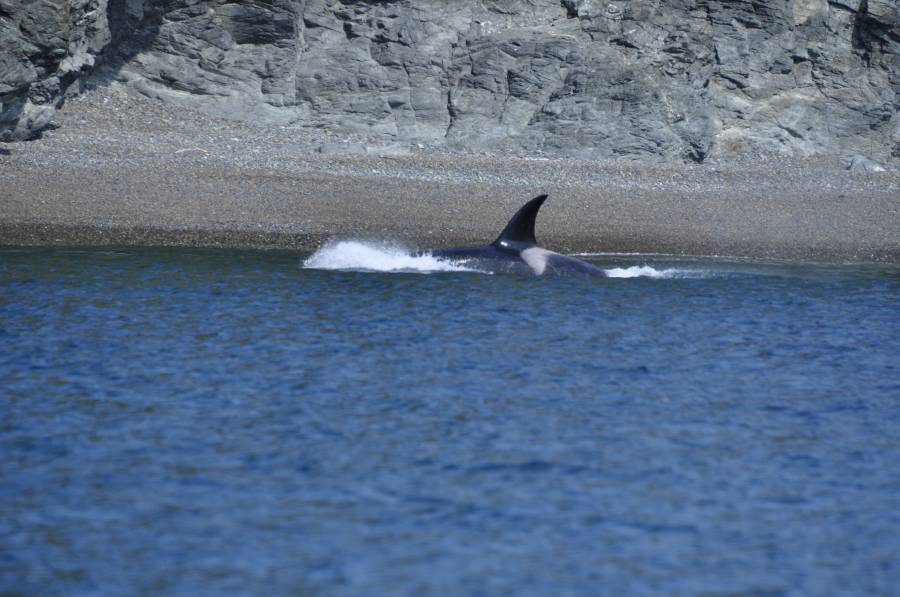
On 2 August we set off from the Balagannoe to the Motykley bay. We spend night at the spit at the north-eastern part of the bay. While surveying the coast we were accompanied with a pod of orcas (Figure 8). The orcas were scraping the shallows and were coming very close to the shore. We saw eagles drawing no attention to orcas. We surveyed the Motykley bay (the rotten corner) on the following day and went along the coast to the Shestakova cape, i.e. getting the same route as in 2011. At the Shestakova cape we hit a sever storm and fog and had to move with the wind to the Talan island.
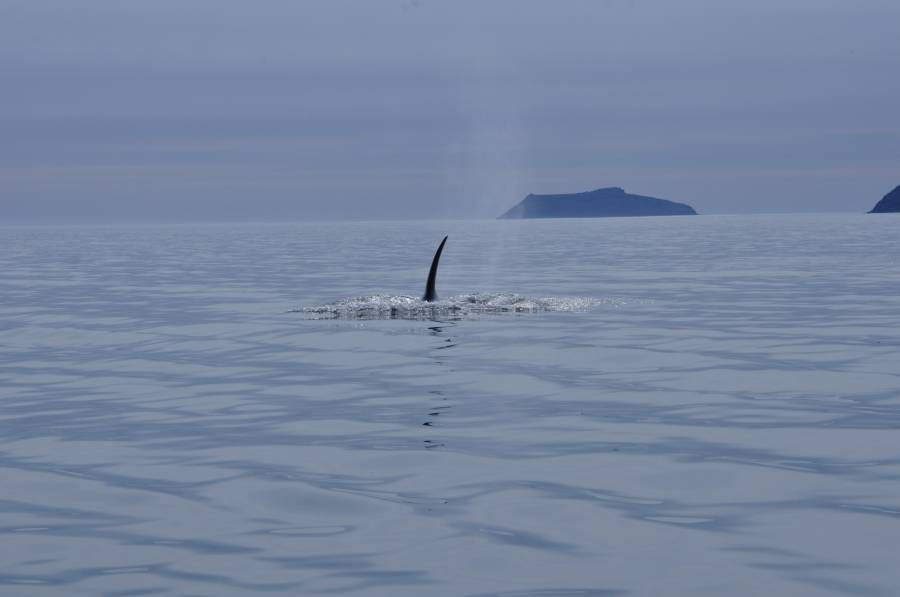
Orca scraping the shore in front of the eagle nest (B10, the nest is not visible). Top: Orca heading towards the boat at the nest B9. Talan island in the view.
The Talan island was covered with thick fog. Our two attempts to check the nests were not successful. However we know that the two occupied nests contained 2 and 2 chicks.
In total this stretch of the coast had 26 occupied nests with 19 chicks. Only 3 nests had duplets.


Odyan Bay trip.
We set off from the Ola on 6 August. We had about 14 hr of the weather window before the cyclone, so we decided to cover the Odyan bay in one go without spending the night. The route was identical to the route of 2011. The sea was relatively calm, and was sunny most of the day.


To our surprise only 3 nests were occupied and with chicks on this coast (1,2 and 2). Total occupied pairs was 11.

I guess the reason of lower breeding output was long period of ice cover which lasted till June (at least what locals told me). I think I will be able to say more about it when I compare ice data.

Staritskogo trip.

We made circumnavigation of the Staritskogo peninsula on 9 August. The route was identical to that of 2011 (Figure 10). On this part of the coast we have 5 occupied nests with chicks (1, 1. 2, 1,1), however the location of the nests changed. Nest A6 was located further away from the Nagaevo bay, S5 is now most productive, nest S2 is no longer occupied, and S4 is now shifted from the birch tree to a sea stack S3. The nest at the resort has only 1 chick compared to 2 last year.


Thursday, June 14, 2012

The Steller’s Sea Eagle surveys of 2012 : 2

The Steller’s Sea Eagle surveys of 2012 


June surveys (by Irina Utekhina)

Since the snow cover in the Magadan area was really below average, we were eager to check the eagle nests as early as possible. The spring flood was short and lasted in 2 weeks of May. By beginning of June the water level has subsided. Irina was accompanied by Andrey Gnezdilov, an amateur photographer from Magadan.


Most of the nests had incubating birds in them. Andrey climbed to 3 nests on Kava and 1 nest on Chelomdja and took pictures by a small camera attached to a pole, similar to the method used by Elsie in 2011.  One nest at the Khuren-Chelomdja confluence had 3 chicks, whose age was estimated as 12-18 days (meaning hatching in May!). [In August we found only 2 chicks in the nest]. At the chum spawning grounds (the last nest on the Chelomja surveys) had one chick whose age was estimated as 1 month. Later in August surveys we saw a large flying chick near the nest.
            Thanks to Andrey’s photo, Irina spotted a male with the wingtag E4 (see August section). This nest was successful for the first time in 3 years.
            Under a new nest a dead chick was found. The female was observed incubating. In August the nest was found to have no chicks. 

Monday, May 14, 2012

The Steller’s Sea Eagle surveys of 2012: 1


The Steller’s Sea Eagle surveys of 2012 

March-April surveys using ultralight


IrinaUtekina has flown 2 missions on an ultralight aircraft on March, 30, 2012 and April, 6, 2012. Both the Kava and Chelomdja were surveyed. The purpose of the flights was to survey density of the moose in the reserve and paid for by the Magadan Game committee (part of the Ministry of Nature Resources). So Irina managed to make the surveys as close to the arrival of the eagles as possible. Technically it was a free ride for us. The Chielomdja flight had to be interrupted due to heavy headwinds, which forced to land the ultralight earlier than expected. There was a steady snow cover in the area at the time of the surveys. There were three new nests found, which are invisible from the river. One was found close to the Central Rangers station. Only one Steller’s Sea Eagle was spotted on Chelomdja.
            Snow cover was exceptionally low. The local hunters failed to shoot moose as they were not able to drive show machines fast enough without damaging them. While flying a forest fire was observed. It is quite a unique phenomenon for the period with snow cover. 

Wednesday, July 27, 2011

A pleasant surprise

Our eaglet has grown! A pleasant surprise came from Japan. An eagle with band 8Z happened to cross a sight of the automatic camera at the Blackstone’s Fish Owl feeding station in Hokkaido. This is the eagle we ringed at the Motykley Bay in 2007.

Wednesday, July 20, 2011

Oil developments

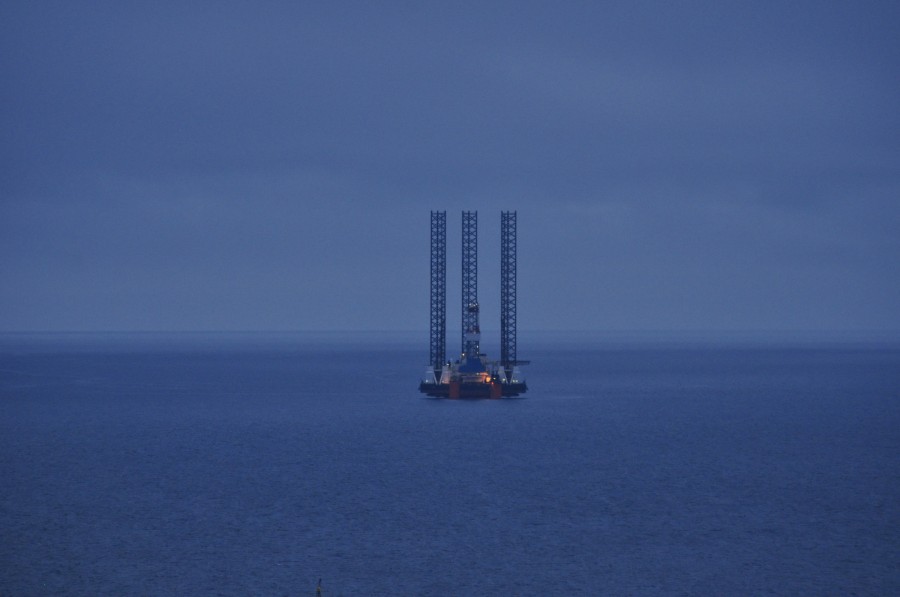
The state oil company demanded drilling rights in the sea coast between the Yamskiye Islands (off the Koni peninsula) to the Lysyanskiy Penninsula. The permission was granted. An oil platform Kolskaya was brought to Magadan from the Kola peninsula (across Cape Horn) and appeared in the Nagaevo bay in early August.
Sadly for the people (not the environment), the platform capsized in December 2011.

Wednesday, July 6, 2011

Field surveys of 2011

The Steller’s Sea Eagle work in 2011

More pictures here Includes June-July trips by Irina Utekhina and Elsie Ashworth of the RSPB (UK); and our routine surveys in end of July and August (Irina Utekhina and Eugene Potapov). June trips. In June there were 2 trips made to the Kava-Cholomdja Portion of the Magadan State Reserve and to the Koni Penninsula. During these trips Irina was accompanied by the RSPB(UK) volunteer Elsie Ashworth. Thanks to superb climbing skills of Elsie who climbed several nests we know that the eagles tried to breed. There were a number of hatchlings in Kava and Chelomdja nests in June, but they all failed to fledge later in the season. So thanks to this season we know for sure that the eagles try to lay even if we do not see fledglings in August. I know that this June was a bit hard for both Irina and Elsie, as they initially though that the eagles were disturbed by the checking of nests. This was not the case, as the nests on Tauy river, which they did not climb, also failed. Elsie deployed a new technique of viewing the nests with severe overhang. She had a small camera in video mode on a stick, which she pushed from under the nest in order to film the nest contents. She managed to film some hatchlings and documented an episode when an older chick was biting smaller one. This behavior suggest that there is some food shortage. Under one nest on the Kava river they found 1 dead chick under the nest. One nest with incubating female was reported fallen into the river. At the end of the June Irina and Elsie visited Koni peninsula portion of the Magadan Nature Reserve and managed to visit some of the nests. The trip was paid for and organized by the Russia Today TV company. They made a short piece on the trip available on internet. You can see it here: http://rt.com/programs/documentary/magadansky-nature-reserve-sea/. Please forgive cormorant from the Commander islands, Humpback whale from the Pacific and Red-tailed Hawk call to document calls of Osprey and Steller’s. For some reasons the journalists always do that. July-August trips. In the end of July- beginning of August we made our customary surveys along the Kava and Chelomdja, as well as the coastal surveys of the Magadan vicinity (Staritskogo Peninsula), Odyan and Motykley Bay. In the end of July- beginning of August we made our customary surveys along the Kava and Chelomdja, as well as the coastal surveys of the Magadan vicinity (Staritskogo Peninsula), Odyan and Motykley Bay. Startiskogo Peninsula trip was made on 23 July. Moderate waves, but otherwise good weather. Staritskogy peninsula returned 3 nests (2 occupied), no nest at the Nedorazumenya Island, 1 occupied nest on the coast facing the Nedorazumenya island. The nest by the Magandan Power Company resort had 2 chicks. I made several trips to the nest on foot when Irina’s daughter was ill and we were delayed in our surveys. Motykley Inlet trip was made on 29 July – 2 August. The number of were somewhat higher compared to the last year. Talan Island had three (3!) active nests with 2 chicks each, but sadly one of the two chicks in the new nest disappeared (presumably took the first flight into the water). The new nest panorama is here http://gigapan.org/gigapans/85461 The weather during the Motykley surveys were not that stable (as usual), however we managed to avoid rough waters and were hit by only one significant storm, which prevented us to go beyond the Shestakova Cape. Basically we had to exercise all survival skills while watching the nest at the Shestakova Cape. We retreated in deep fog to the Talan Island. Survey of the Spafarieva island was unthinkable due to fog. A. Andreev who was at the Talan at the time noted that the fog at the Spafarieva stayed there almost all 3 weeks and they were reluctant to go there. We went back to Balagannoe from the Talan island. The surveys of the Kava Chelomdja portion of the Magadan State Nature Reserve was carried out on 3-7 August 2011. We covered our usual study area (upstream to the upper chum spawning grounds at the Chelomdja (overnight at the Kheta ranger’s station), and up to the Ikremun ranger’s station on the Kava. All chicks which were reported in June by Irina and Elsie were no longer there. Only one nest (on Tauy river, at the estuary, outside the reserve) had a chick. The river system of Kava-Chelomdja did not produce any chicks. On the way back we got some new data on the floods at the Talon. The data on floods supplied by the Talon meteorological station proved to be of a great value. These data (snow depth) allowed us predicting the low breeding output in 2011 on the rivers already in early May. High and long flood this year indeed resulted in zero breeding output. This effectively means, that we can not only predict the breeding output of the eagles based in the snow depth in May, but also plan measures which can offset the results of high floods. What I have in mind, is to create a feeding station, such as a raft with mesh bottom, and get the rangers to put some live fish in it. A pilot experiment at a nest near ranger’s station might be a good start for the next year. Odyan Bay trip. We made a survey of the Odyan Bay on 8 and 9 August. The weather was tolerable. We surveyed Ola coast from the lagoon to the Umara Island and camped at the Naidenaya Bay. The numbers of the breeding eagles was comparable to the previous years surveys. No large concentrations of the immature and single eagles were observed on the Northern coasts of the Koni peninsula, in contrast to that of 2010. The nest at the Umara island was present, occupied and had one chick after a long break.

Monday, June 13, 2011

End of the track

Sadly the bird's last coordinates were heard on April, 24, 2011 from the ice floe near the coast. The temperature of the transmitter showed negative values, which means only one thing, the bird is no longer alive.
The remote location of the last coordinates and ice breaking conditions excludes the possibiliy of human-caused death.